
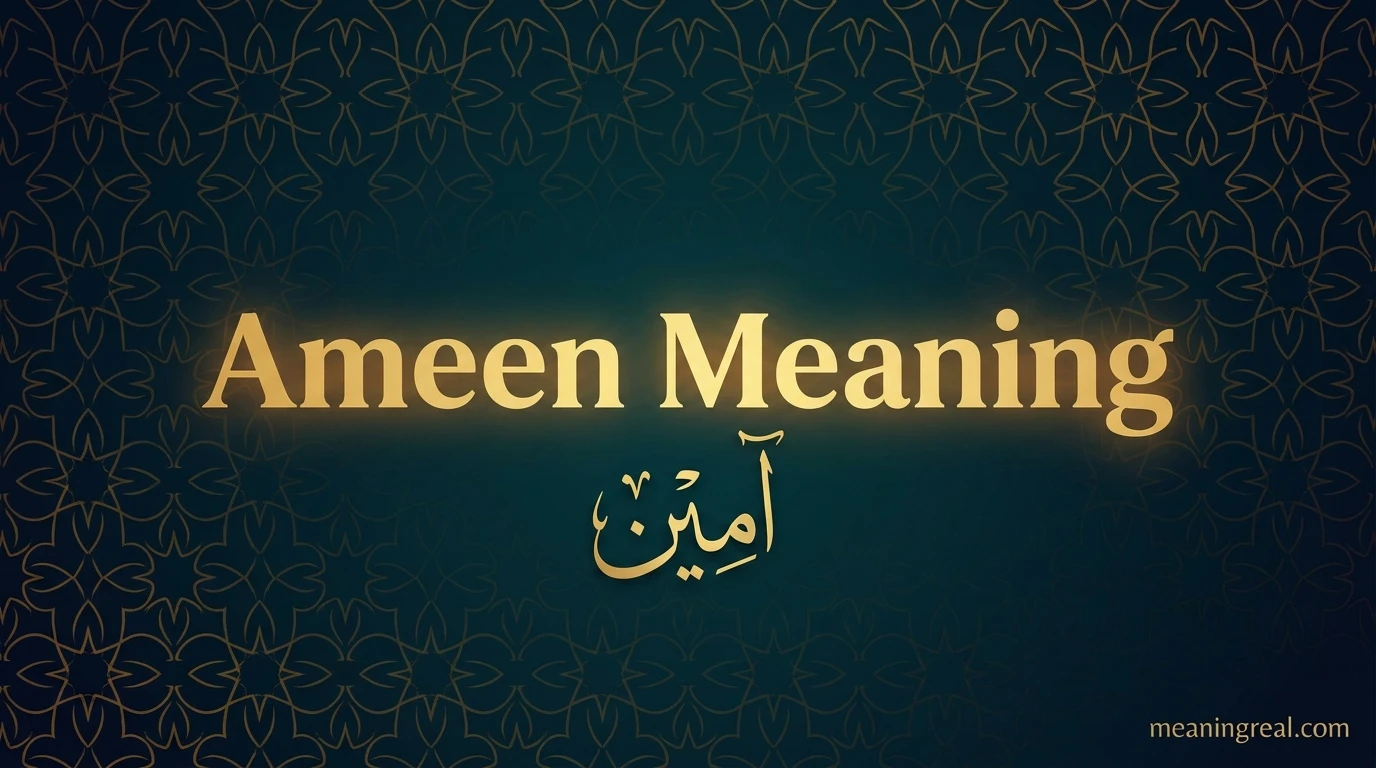
Ameen meaning in Arabic is “may it be so” or “O Allah, answer it,” and it is written آمين. It is pronounced Aa-Meen, with the stress on the second syllable. Muslims say it after a du’a, especially after Surah Al-Fatihah, to ask Allah to accept the supplication. Ameen is not just a polite response; in Islamic use, it turns the listener into a participant in the prayer.
The word is common across Muslim communities, and it carries both agreement and hope. That is why a simple ameen can sound quiet, but it still holds real spiritual weight. In a mosque, it can shift the room into one shared answer.
What Does Ameen Mean in English?
In English, ameen is closest to “may it be so,” “let it be accepted,” or “O Allah, answer.” The Arabic form is آمين, and the emphasis falls on the second syllable: Aa-Meen.
It is a short word, but it does more than say “yes.” A Muslim might hear a du’a in the mosque, then answer with ameen to show agreement and to ask Allah to accept what was said. In a family prayer after dinner, that tiny reply can carry a lot of warmth, because it joins everyone to the same hope.
The word works because it is simple and serious at the same time. In family speech, it can feel gentler than a plain “okay,” because it keeps the prayerful feeling alive. It closes a supplication without closing the feeling behind it, which is why it sounds natural in both private prayer and group worship. In that sense, ameen is less like a sentence and more like a shared spiritual cue.
Where Does Ameen Come From?
Ameen comes from a shared Semitic religious tradition, and Arabic speakers often connect it with the root أ-م-ن (A-M-N), which carries ideas of trust, faith, and safety. The exact etymology is debated, so it is better to speak carefully than to claim certainty where scholars still discuss the details.
In everyday Arabic, the word functions as a prayerful affirmation rather than a normal dictionary noun. That is why it feels different from ordinary conversation and why it sounds older than the sentence around it.
It belongs to Muslim devotional language across regions, from Modern Standard Arabic to daily spoken Arabic. You hear it in mosques, homes, WhatsApp voice notes, school gatherings, and after personal du’a. That wide spread is part of what makes the word so recognizable. A child can learn it early, then carry it into prayer for the rest of life.
What matters most is the function, not the debate. People say ameen when they want the prayer to be accepted, and that use has stayed stable across generations.
When Do Muslims Say Ameen?
Muslims say ameen after hearing a du’a, and they also say it after the imam finishes Surah Al-Fatihah in congregational prayer. That is the most common and most recognizable use.
It can also appear in private prayer, in family settings, and in a supportive reply when someone else makes a heartfelt supplication. A mother might pray for her children and hear everyone answer ameen together, which gives the moment a shared feel. A friend might send a prayer in a group chat, and the reply still works the same way.
The word is not something Muslims insert into every sentence. You do not say it after ordinary facts, jokes, or neutral statements, because it belongs to prayerful speech.
So if someone makes a normal statement, ameen is not the right reply. It belongs to moments when the speaker is hoping for divine acceptance, not just polite agreement. It belongs to moments when the speaker is hoping for divine acceptance, not just polite agreement.
Why Is Ameen So Important in Islam?
Ameen is important in Islam because the Prophet Muhammad ﷺ instructed believers to say it when the imam reaches the end of Surah Al-Fatihah, and the hadith connects that moment with the angels’ ameen and forgiveness. The report is found in Sahih al-Bukhari 782 and Sahih Muslim 410, linked to Al-Fatihah 1:7.
The key point is that ameen is not passive agreement. It is a spoken wish that Allah accept the du’a, which is why its role is deeper than a simple “so be it.” That is the correction many articles miss when they flatten the word into a generic translation.
Islamic scholars also treat the word as a Sunnah-linked response in the right prayer context. In congregation, it helps the whole group share one prayerful moment instead of keeping the response private. The sound is small, but the meaning is communal. That shared timing is one reason the word feels so natural when an entire row says it together. That is the correction many articles miss when they flatten the word into a generic translation.
Islamic scholars also treat the word as a Sunnah-linked response in the right prayer context. In congregation, it helps the whole group share one prayerful moment instead of keeping the response private. The sound is small, but the meaning is communal.
Ameen vs. Similar Expressions
Ameen is not the same as inshallah, alhamdulillah, or the English “amen” in casual speech. Inshallah looks toward the future, alhamdulillah thanks Allah for something already given, and ameen asks for acceptance of a supplication.
That difference matters in real use. If someone says, “May Allah give you ease,” ameen fits naturally after the du’a, while inshallah would shift the meaning toward a future event. If someone says a blessing or a heartfelt prayer, ameen keeps the response inside that prayer.
English “amen” is close in function, but Muslim use still carries its own prayer context. The word sounds familiar across faiths, yet the setting changes what it does.
If you keep the setting in mind, the choice becomes easy. Ameen responds to prayer, inshallah points to the future, and alhamdulillah answers gratitude.
What Are the Common Mispronunciations and Misuses?
Ameen is pronounced Aa-Meen, with the stress on the second syllable. English speakers sometimes say AY-meen, which pushes the stress too far forward and makes the word sound less natural.
Some people also shorten it too much and lose the long first vowel. That can make the word sound rushed, especially in prayer where a slower, steadier sound feels more respectful.
Another common mistake is saying it casually after any statement that sounds hopeful. That drains the word of its prayerful force and makes it feel like filler rather than intention. People also use it as a decorative religious word in captions, without any real prayer behind it.
People also spell it in different ways, including ameen, amin, and aameen. Those spellings can all point to the same word, but the pronunciation should still keep the long first vowel and the clear second-syllable stress.
The word loses force when it becomes mechanical. Said well, it sounds like faith; said carelessly, it sounds like habit. Children often learn it by hearing adults say it together, so the sound matters as much as the spelling. A careful ameen feels alive; a rushed one can feel empty.
What Ameen Carries in Real Muslim Life
Ameen carries shared hope, not just a response. When a room full of people says it after a du’a, the word creates a small moment of unity.
You hear that in mosques, at family dinners, during wedding prayers, and in private messages between friends who are asking Allah for the same thing. The setting changes, but the basic feeling stays the same. Even in a text message, it can carry the warmth of a real prayer.
Older speakers often say it with a quiet, settled tone, while younger speakers may stretch it in texting or voice notes. Still, the meaning stays rooted in asking Allah to accept what was said.
That is why the word survives so well across Muslim cultures. It gives people a shared ending to a prayer, even when their dialects differ. It leaves the prayer open to Allah’s answer instead of closing it with the last spoken line.
Conclusion
Ameen is a small Arabic word with a big spiritual job. It closes a du’a, strengthens the prayer, and asks Allah to accept what was asked.
In real life, you will hear it after supplication in the mosque, at home, or in a message from someone asking for prayer. The word sounds simple, but its purpose is serious.
It belongs to the heart of Muslim speech, where agreement and worship meet, and where the final word is still left to Allah. That is why the word feels small on paper but large in practice.
Frequently Asked Questions
Ameen means “may it be so” or “O Allah, answer it” in Arabic. Muslims say it after a du’a to ask Allah to accept the prayer.
Say it Aa-Meen, with the stress on the second syllable. Keep the first vowel long and open.
The word ameen is not a standalone Quranic word in the way people often expect. Its strongest Quranic connection comes through Surah Al-Fatihah 1:7, where Muslims say it after the imam finishes the verse.
Muslims say ameen after du’a and after the imam finishes Al-Fatihah in congregational prayer. They also say it in family prayers and personal supplications.
Yes, when it is used respectfully in a prayer context. The word itself is a response of affirmation and a request for acceptance.
Ameen asks Allah to accept a supplication. Inshallah means “if Allah wills” and points to a future event.
They are very close in function. Both words express affirmation at the end of prayer.