
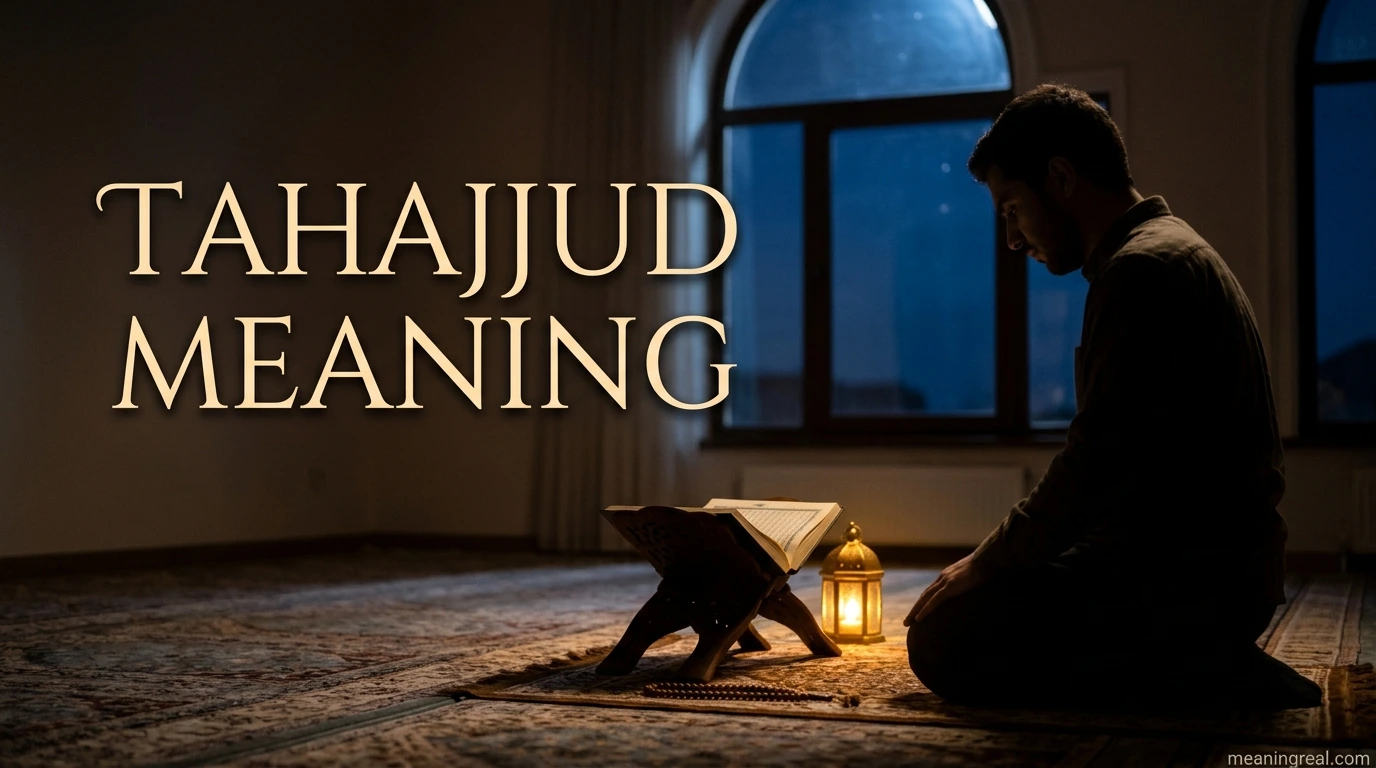
Names carry stories. Some are light and playful, others arrive with a quiet gravity that makes people pause and ask questions. Tahajjud belongs firmly to the second group. The moment you hear it, you sense there’s something deeper beneath the surface—something connected to stillness, devotion, and the hours when the world sleeps.
If you’ve landed here, you’re probably curious about more than just a dictionary definition. Maybe you’ve met someone named Tahajjud, or you’re considering it for a child, or you simply stumbled upon the word and felt drawn to it. Whatever brought you here, this guide will walk you through the tahajjud meaning from every angle: its linguistic roots, its pronunciation, its cultural weight, the personality traits people associate with it, and the everyday ways it shows up in language. By the end, you’ll understand not just what the name means, but why it feels the way it does.
What Does Tahajjud Mean?
At its core, Tahajjud (تهجّد) refers to the voluntary night prayer in Islam—the prayer offered after sleeping and waking in the quiet hours before dawn. The word itself carries the sense of “waking up at night,” “keeping vigil,” or “struggling through the night in devotion.”
When used as a name, Tahajjud inherits this entire atmosphere. It isn’t simply “night prayer” in a technical sense; it suggests wakefulness, intention, and a deliberate choice to rise when others rest. A person named Tahajjud carries a name that means something like “one who wakes in the night for worship” or “the vigilant one.”
This is a name with weight. It doesn’t describe appearance or fortune—it describes an act of devotion. That’s part of what makes it so striking.
The Origin of the Name Tahajjud
Tahajjud comes from Arabic and is deeply rooted in Islamic tradition. It is not a name in the casual sense—it’s a religious term first, and a personal name second. This dual identity gives it a unique place among Arabic names.
The concept of tahajjud appears directly in the Quran, most famously in Surah Al-Isra (17:79), where believers are encouraged to pray at night as a voluntary act that raises their station. Because of this scriptural anchor, the word has been preserved for over fourteen centuries with remarkable consistency in meaning and pronunciation.
As a given name, Tahajjud is rare but not unheard of. It tends to appear in families who value its spiritual significance, often in South Asia, the Middle East, and Muslim communities in the West. Parents who choose it usually do so with intention—they want a name that reflects devotion rather than fashion.
The Linguistic Root: Where the Word Comes From
To really understand tahajjud meaning, it helps to look at the root letters: ه – ج – د (hāʾ – jīm – dāl).
This root, hajada, carries the idea of sleeping—but specifically, the deeper linguistic layers point to a kind of sleep that is followed by waking. The form tahajjada means “to wake up after sleeping,” particularly for a purpose. Classical Arabic lexicographers explain it as staying awake in the night, often for prayer or reflection.
There’s a beautiful subtlety here. The word doesn’t just mean “awake.” It means awake after having been asleep—a deliberate interruption of rest. That nuance is what gives the name its emotional texture. It’s not about insomnia or restlessness; it’s about chosen wakefulness.
How to Pronounce Tahajjud
Pronunciation can be intimidating for non-Arabic speakers, but it’s more approachable than it looks.
Tahajjud is typically pronounced: tah-HAJ-jood
- Tah — like “ta” in ta-da, short and light
- HAJ — rhymes with “badge,” with emphasis on this syllable
- jood — like “jude” with a slightly longer “oo” sound
In Arabic script: تهجّد
A few notes:
- The “h” in the middle is a soft, breathy sound (ح), not a hard “h.”
- The double “j” (جّ) is emphasized—hold it for a beat.
- The final “d” is crisp and clean.
It’s a name that flows well once you’ve heard it a few times. Most people find it easier to say than it looks on paper.
Personality Traits Associated with Tahajjud
In name-meaning traditions, especially within Islamic and Arabic cultures, names are often believed to shape character—or at least reflect the qualities families hope to nurture. Tahajjud brings a specific set of associations:
Thoughtful and reflective. The name belongs to the quiet hours, and people named Tahajjud are often described as introspective—the kind of person who thinks before speaking and notices what others miss.
Spiritually grounded. Given its religious origin, the name is linked to devotion, discipline, and a strong inner moral compass.
Disciplined but gentle. Waking for night prayer requires willpower, but it’s a soft, private discipline. The name reflects that balance—strength without showiness.
Reserved in public, warm in private. Like the prayer itself, which happens away from the world’s eyes, Tahajjud suggests someone who saves their deepest warmth for close relationships.
These are associations, not predictions. But they explain why parents are drawn to this name—it signals values rather than just sounds.
Cultural and Religious Significance
Tahajjud is more than a name—it’s a lived practice in Islamic culture.
The night prayer is considered one of the most intimate forms of worship. Unlike the five daily prayers, tahajjud is voluntary. It’s offered in the dark, often alone, when no one is watching. This gives the word a special kind of respect in Muslim communities. It’s associated with sincerity, since there’s no social reward for waking at 3 a.m. to pray.
In the Quran, tahajjud is mentioned as a means of attaining a “praiseworthy station” (maqam mahmud). Islamic scholars have long described it as a habit of the righteous—a way of drawing closer to God through silence and stillness.
As a name, Tahajjud carries this cultural reverence. It’s not chosen casually. In many families, giving a child this name is itself an act of prayer—a hope that the child grows up with the qualities the name represents.
Real-Life Usage: How Tahajjud Appears in Language and Culture
In everyday Arabic and Muslim communities, tahajjud is used in a few distinct ways:
As a religious term: “He prays tahajjud every night.” “She woke up for tahajjud before Fajr.”
As a name: “Tahajjud is joining our class this year.” “I asked Tahajjud to help with the project.”
In cultural conversation: “The imam spoke about the virtues of tahajjud last Friday.”
It’s worth noting that when used as a name, it’s often accompanied by a nickname or shortened form—since it’s a longer name, families might use “Tahaj,” “Jjud,” or a completely separate affectionate name. This is common with distinctive Arabic names; the full name carries the meaning, while daily life uses something softer.
In Western contexts, people named Tahajjud often find themselves explaining the name’s origin. This isn’t a burden—most describe it as a conversation starter. The name invites curiosity, and the explanation usually leaves people impressed.
Common Mistakes and Misunderstandings
Because tahajjud is rare as a name, a few misunderstandings tend to pop up:
“Is it a girl’s name or a boy’s name?” In most communities, tahajjud is used for both, though it’s slightly more common for girls in some regions and for boys in others. It’s not strongly gendered. Some families use it as a unisex name.
“Does it mean ‘prayer’ in general?” No—it specifically refers to the voluntary night prayer. It’s not the same as salah (the general word for prayer) or qiyam (standing in prayer). Tahajjud is the late-night, after-sleep prayer.
“Is it a word or a name?” Both. It’s a religious term that has been adopted as a personal name. That dual identity is part of its charm.
“Is it pronounced ‘Ta-ha-jood’ or ‘Tah-jood’?” The correct form is tah-HAJ-jood, with emphasis on the middle syllable. Skipping the “haj” part changes the rhythm and loses the sound of the root.
“Is it only for religious families?” Not necessarily. Some parents choose it purely for its sound or meaning, even if they aren’t particularly observant. The name is spiritual, but it doesn’t require a certain level of practice to be meaningful.
Tahajjud as a Modern Name Choice
In recent years, there’s been a growing trend toward meaningful, uncommon names—names that carry a story rather than just a pleasant sound. Tahajjud fits that trend perfectly.
For parents, it offers:
- Distinctiveness without being invented
- Deep roots in a respected tradition
- A meaningful message about stillness, devotion, and inner life
For people named Tahajjud, the name often becomes part of their identity in a positive way. Many describe feeling a quiet pride in it—it’s not a name you share with five other people in your class, and its meaning gives them a sense of purpose.
It’s also worth mentioning that the name travels well. While it’s Arabic in origin, it’s pronounceable in most languages once explained. It doesn’t require special spelling changes, and it retains its dignity in any setting.
Variations and Related Names
If you’re exploring tahajjud meaning, you might also be curious about names in the same family:
- Tahajjud — the original form
- Tahajjudah — a slightly softened variant used in some regions
- Tahaj — a shortened, affectionate form
- Qiyam — refers to standing in night prayer, closely related in meaning
- Tahmid, Tasbeeh, Tahleel — other devotional terms sometimes used as names
Each carries its own nuance, but tahajjud remains the most specific—and the most evocative.
FAQ: Common Questions About the Name Tahajjud
1. Is Tahajjud a male or female name? It’s used for both. In some cultures it leans feminine, in others masculine. It’s best described as unisex.
2. Can non-Muslims use the name Tahajjud? Technically, yes—names aren’t restricted by religion. However, because it’s a specifically Islamic term, non-Muslim families might want to consider whether the religious meaning fits their context. It’s a name best given with understanding of its origin.
3. What is the meaning of Tahajjud in English? It translates roughly to “waking up at night for prayer” or “night vigil.” As a name, it suggests vigilance, devotion, and chosen wakefulness.
4. Is Tahajjud mentioned in the Quran? Yes. The concept appears in Surah Al-Isra (17:79) and Surah Al-Muzzammil (73:6), where night prayer is praised as a means of spiritual elevation.
5. How do you spell Tahajjud in Arabic? تهجّد
6. Is Tahajjud a common name? No. It’s rare, which is part of its appeal. You’re unlikely to meet many people with this name.
7. Can Tahajjud be shortened? Yes. Common short forms include Tahaj, Jjud, or a family-chosen nickname. The full name is usually kept for formal contexts.
8. What is the difference between Tahajjud and Qiyam? Qiyam refers broadly to standing in night prayer. Tahajjud specifically refers to the night prayer offered after sleeping. All tahajjud is qiyam, but not all qiyam is tahajjud.
Conclusion: The Essence of the Name
Tahajjud is a name that asks something of you—not in a demanding way, but in a quiet, steady one. It means waking when the world is still, choosing devotion over comfort, and finding meaning in the hours no one else sees. As a name, it carries that same spirit: thoughtful, grounded, and deeply sincere.
For anyone searching for tahajjud meaning, the answer goes beyond a simple definition. It’s a name about intention. About rising. About the kind of person who chooses to be awake—not just physically, but spiritually.
Whether you’re considering it for a child, writing about it, or simply curious, the name leaves an impression. It’s rare, but it isn’t strange. It’s old, but it isn’t outdated. And it means something worth holding onto: that even in the darkest hours, there’s purpose in waking up.