
Few names carry as much history and symbolism as Tariq. It appears in classrooms, on passports, in poetry, and in everyday conversation across continents—yet many people who encounter it wonder what it truly means. Some are expecting parents searching for the perfect name, curious whether Tariq suits their child. Others have just met someone named Tariq and want to understand the name’s cultural weight. Parents naming a newborn, readers meeting the name in a book, or friends who simply love names—all of them discover that a name is never just a name.
What makes Tariq especially fascinating is that its meaning isn’t one-dimensional. It points to the quiet of night, the first light of dawn, a knocking at the door, and one of the most famous journeys in Islamic history. This article will walk through all of it—the meaning, the origin, the pronunciation, the personality traits people associate with the name, its cultural significance, and the little details that most quick-glance websites skip. If you’ve ever wondered what Tariq really means and how it’s used, this guide is for you.
What Does the Name Tariq Mean?
At its core, Tariq (طارق) means “the one who knocks” or “the night visitor.” The name is derived from the Arabic root ط-ر-ق (ṭ-r-q), which carries the sense of striking or knocking. A tariq is someone who comes at night and knocks at the door—a guest arriving under cover of darkness.
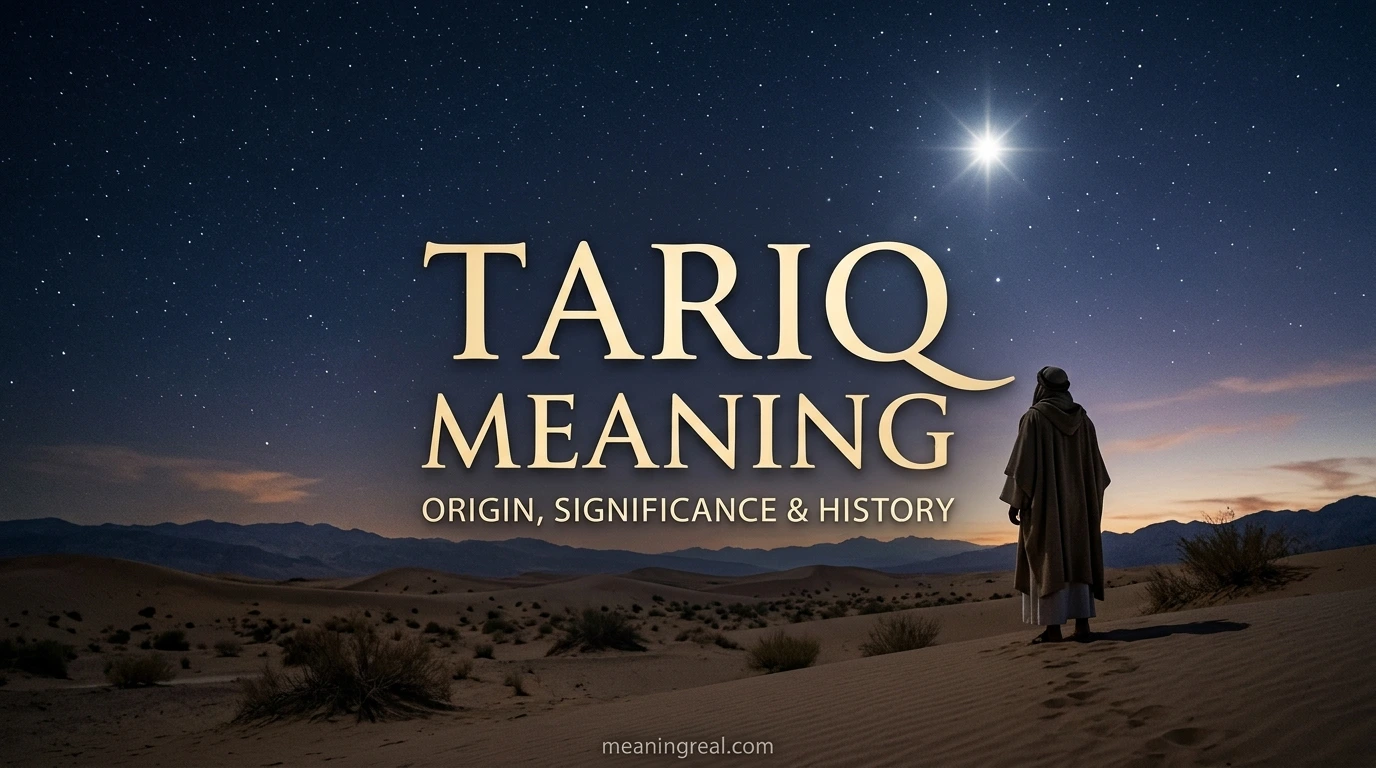
From this root comes another beautiful layer of meaning. Tariq is also connected to the word tariqah, meaning a path or way. And in Arabic, the morning star—the bright star that appears at the end of the night and signals the coming dawn—is called al-Tariq and najm al-tariq. So the name quietly holds both the darkness of night and the promise of light. A person named Tariq is, in a poetic sense, the one who knocks at the door of the night and the star that guides the way.
For parents, this duality is often what makes the name appealing: it’s strong without being harsh, spiritual without being heavy. In everyday use, saying “Tariq means the night visitor” is a simple and accurate way to explain it. More precisely, it means “the one who knocks at night” or “the morning star.”
Where Does the Name Tariq Come From?
Tariq is an Arabic name with deep roots in pre-Islamic Arabia, Islamic history, and the wider Semitic linguistic world. It belongs to the same broad family of names as other Arabic classics like Amir, Zayd, and Yasmin, but it stands out because of its vivid imagery.
The name’s most celebrated historical connection is Tariq ibn Ziyad, the Berber Muslim commander who, according to tradition, led the conquest of the Iberian Peninsula in 711 CE. Legend says that after landing at the Rock of Gibraltar—Jabal Tariq, meaning “Mountain of Tariq,” which is how Gibraltar got its name—he ordered his ships burned and delivered a famous speech urging his soldiers to fight with courage. Whether every detail of that story is historically exact or partly legend, the association has cemented Tariq as a name of leadership, boldness, and crossing into the unknown.
Because of this history, the name spread far beyond Arabic-speaking communities. It is now common among Muslims in South Asia, the Middle East, North Africa, and diaspora communities in Europe and North America. It’s also found among non-Arab Muslims in Indonesia, Malaysia, and Turkey (where it often appears as Tarık). In short, Tariq is a genuinely global name with a distinctly Arabic heart.
The Linguistic Roots: What Does ط-ر-ق Really Mean?
The three-letter root ط-ر-ق (ṭāʾ-rāʾ-qāf) is one of the most productive roots in Arabic, and exploring it explains much of the name’s richness.
- طَرَقَ (ṭaraqa) – “to knock” or “to strike.” This is the most basic verb. A person who knocks is a ṭāriq.
- طَرِيق (ṭarīq) – “road” or “way.” Interestingly, the word for road comes from the same root, because a road is something that is “struck” or worn by travelers.
- طَارِق (ṭāriq) – “night visitor” or “one who comes at night.” Classical Arabic poetry used ṭāriq for the midnight knocker, sometimes a traveler, sometimes a stranger.
- الطَّارِق (al-ṭāriq) – In the Quran, al-ṭāriq refers to the morning star. Surah At-Tariq (Chapter 86) opens with “By the sky and the night visitor—and what will make you know what the night visitor is? It is the piercing star.”
This last point is important because it shows how the name moves seamlessly between the everyday (someone knocking at the door) and the cosmic (a star piercing the darkness). In Arabic, the same word can describe a human visitor and a heavenly light. That’s part of what makes Tariq feel both grounded and elevated.
How Do You Pronounce Tariq?
The name is pronounced TAH-rik in English, with the stress on the first syllable. The “q” at the end is a soft k sound for most English speakers. In Arabic, it’s closer to TAA-riq, where the final letter ق (qāf) is pronounced deep in the throat—a sound that doesn’t exist in standard English.
Here’s a simple breakdown:
- TAH – rhymes with “ah” or “father”
- riq – rhymes with “reek” but shorter, ending in a light k
Variations include Tarik (Bosnian, Turkish Tarık, and common in the Balkans), Tareq (popular in Egypt and the Levant), and Tariq (the most common spelling in South Asia and the diaspora). None of these spellings is “wrong”—they reflect local pronunciation and transliteration preferences. In daily conversation, people often shorten it to “Tari” or “Taz” among friends, especially in English-speaking countries.
What Kind of Personality Is Associated with Tariq?
Names carry expectations, and Tariq has a distinct personality profile in the cultures where it’s common.
- Bold and adventurous. Thanks to Tariq ibn Ziyad, the name is associated with courage, risk-taking, and the willingness to step into the unknown. People tend to expect a Tariq to be a natural leader—someone who makes decisions and stands behind them.
- Thoughtful and intuitive. The “night visitor” and “morning star” imagery gives the name a contemplative side. Tariqs are often described as observant, curious, and quietly wise—people who notice what others miss.
- Warm and social. The “knocking at the door” meaning is a reminder of hospitality. In Arab culture, a guest is a blessing, and a knock at the door is a welcome event. Many families say their Tariq is the sociable one, the friend who brings people together.
- Ambitious but principled. Because the name is tied to faith and history, parents often hope a Tariq will grow up with strong values. Teachers and family members frequently describe Tariqs as hardworking and principled.
Obviously, no name determines a person’s character. But these associations shape how people hear the name, and they’re worth understanding if you’re considering it for a child.
Tariq in Culture: History, Religion, and Everyday Life
Tariq ibn Ziyad and the Rock of Gibraltar
The most famous Tariq in history is Tariq ibn Ziyad, the commander whose name became attached to the Rock of Gibraltar. Jabal Tariq—the Mountain of Tariq—became “Gibraltar” in European languages. This story is taught in schools across the Arab world and Spain, and it’s why the name Tariq is often linked to exploration, ambition, and history-making.
Tariq in the Quran and Islamic tradition
Surah At-Tariq is named after the morning star, and the word appears in the Quran as a symbol of divine power and guidance. This gives the name religious weight without making it strictly a “religious name.” Many Muslim parents choose Tariq because it honors both faith and heritage, and it’s widely accepted across different schools of thought.
Tariq in modern culture
The name has also entered popular culture in interesting ways. In the 1990s and 2000s, a character named Tariq appeared in the Call of Duty video game series, and the name shows up in novels, TV shows, and sports. In sports, names like Tariq Abdul-Wahad (the first French Muslim to play in the NBA) and many cricketers and footballers named Tariq have kept the name visible in headlines, In Pakistan and India, Tariq is a common name among journalists, actors, and public figures—there’s a familiarity to it that helps it travel across media.
Daily usage examples
In daily language, Tariq is used as a given name and occasionally as a surname. Example sentences:
- “Tariq knocked on the door just after sunset, holding a plate of sweets for the neighbors.” (This plays on the name’s literal meaning.)
- “My classmate Tariq always has a story to tell about his grandfather’s travels.”
- “We named our son Tariq because we loved the idea of a name that means both a visitor and a star.”
In Arab culture, saying “Tariq” at a gathering might prompt a smile and a comment about the name’s historical weight. In South Asia, it’s often shortened affectionately to “Tari” or “Tariq bhai” (brother Tariq), In English-speaking contexts, people sometimes remark that it’s “a strong name”—a small moment of recognition that the name carries meaning.
Spreading Around the World: Tariq Across Languages and Regions
Tariq has traveled widely, and each region has its own flavor of the name.
- Turkey: Tarık, with the dotless ı, is common. Turkish pronunciation is close to “Tuh-RUK.”
- Bosnia and the Balkans: Tarik is the standard spelling, widely used among Bosniak families.
- Egypt and the Levant: Tareq is a frequent spelling, and the name is popular among both Muslims and some Christians in the region.
- South Asia (Pakistan, India, Bangladesh): Tariq is very common among Muslim families and often appears in compound names like Tariq Mahmood or Tariq Jameel.
- Indonesia and Malaysia: Tariq and Tareq appear among Muslim communities, sometimes with local spellings like Thariq.
- The West: In the United States, United Kingdom, Canada, and Australia, Tariq is a recognizable name in Muslim diaspora communities and has become familiar to the wider public through athletes, actors, and public figures.
This variety means that if you meet a Tariq, he might be from Lahore, Istanbul, Cairo, London, or Chicago—and the name will feel at home in all those places.
Common Mistakes and Misconceptions
A few misunderstandings pop up often when people talk about Tariq.
- “It means ‘morning star,’ full stop.” It’s true that the morning star is one meaning, but the name also means “night visitor” and “one who knocks.” Both layers belong to the name; skipping one gives an incomplete picture.
- Confusing Tariq with similar names. Tariq is sometimes mixed up with Tariqah (a Sufi order or spiritual path), Tariq as a surname, or Tarık in Turkish. They’re related but distinct.
- Assuming it’s only a Muslim name. While it’s deeply rooted in Arabic and Islamic culture, Tariq is used by Arabic-speaking Christians and others. It’s an Arabic name with cultural and religious associations—not a strictly religious label.
- Mispronouncing the final qāf. English speakers often turn the final sound into a hard k, which is perfectly acceptable. But native Arabic speakers pronounce a deeper q sound, and some people worry this makes their pronunciation “wrong.” It doesn’t—both are normal.
- Assuming all spellings are equally common everywhere. Tareq is common in Egypt; Tarik in Bosnia and Turkey; Tariq in South Asia. Spelling preferences often reflect geography rather than personal style, and it’s fine to choose whichever spelling suits your family’s background and preferences.
The Name in Daily Life: What It’s Like to Be Called Tariq
People named Tariq often report a few recurring experiences. In English-speaking countries, they’re sometimes asked “Is that your real name?” or “How do you pronounce that?”—a small but familiar ritual. Spelling can be a challenge: “Tariq,” “Tarik,” “Tareq,” and “Tarique” are all out there, so a Tariq might say “Tariq with a q” when ordering a coffee.
At the same time, the name carries a warm social currency. Hearing “Tariq” in a classroom or a workplace often triggers a comment about the name’s meaning or its famous historical bearer. Many Tariqs say the name makes a good conversation starter—particularly in history or language classes. And in Muslim communities, the name signals connection: it’s a name that grandparents recognize instantly and that children learn to spell early.
In daily language, the word tariq (especially in the form al-tariq) also appears in Arabic speech to describe the morning star, and in poetry to describe a traveler arriving at night. The name and the common noun share the same root, which is why Arabic speakers often feel a little poetic echo when they say it.
Variations, Nicknames, and Related Names
If you like Tariq, you might also appreciate these related options:
- Tariq / Tarik / Tareq / Tarique – spelling variations across regions.
- Tarık – Turkish form, with a distinctive vowel.
- Tariqah / Tariqa – a related word meaning “path” or “spiritual order” in Sufism. It’s not usually a given name, but it shares the root.
- Tariq ul-Islam – a compound form sometimes used in South Asia, meaning “the path of Islam.”
- Nicknames: Tari, Taz, T-T, Riq, or simply “T”—families often invent their own.
- Related names in meaning: Sariq (a different Arabic name), Najat (salvation), Mishal (torch), and Sahar (dawn)—names that share the imagery of night, guidance, or light.
Is Tariq a Good Name for a Baby?
Parents considering Tariq usually want a name that is meaningful, easy to recognize, and culturally rooted. Tariq checks all three boxes. It’s short (five letters), pronounceable in many languages, and carries a story worth telling.
A few practical considerations:
- Spelling. Decide early whether you prefer Tariq, Tarik, Tareq, or Tarique. Each has regional loyalties; the most globally common is Tariq.
- Pronunciation. In English-speaking countries, expect “TAH-rik.” It’s easy for teachers, doctors, and friends to say once they’ve heard it.
- Cultural fit. If your family has Arabic, South Asian, Turkish, or Muslim heritage, Tariq will feel immediately at home. If not, it’s still a beautiful cross-cultural choice—just be prepared to explain its meaning often, which many Tariqs say they enjoy.
- Middle names. Tariq pairs well with short middle names (Tariq Ali, Tariq James) and longer ones (Tariq Mahmood, Tariq Alexander). In South Asia, “Tariq Ahmed” and “Tariq Hussain” are common combinations.
Frequently Asked Questions About the Name Tariq
1. What is the full meaning of the name Tariq? Tariq means “the one who knocks” or “night visitor,” and it also refers to the morning star—the bright star that appears at the end of the night. The name combines the idea of a knock at the door with the image of a star that signals the coming dawn.
2. Is Tariq mentioned in the Quran? The word al-tariq (the night visitor / morning star) appears in Surah At-Tariq, chapter 86 of the Quran. The name itself isn’t a direct verse, but its root and imagery are strongly connected to that chapter, which is why many Muslim families find the name especially meaningful.
3. Is Tariq an Arabic name or a Muslim name? It’s an Arabic name with deep roots in Islamic history and culture. Many Muslims use it, but it’s not exclusively Muslim—Arabic-speaking Christians and secular families also use it. Think of it as an Arabic name with cultural and religious resonance.
4. How do you pronounce Tariq correctly? In English, say TAH-rik with the stress on the first syllable. The final “q” is a light k sound. In Arabic, the final letter is a deeper q sound, but the English pronunciation is widely accepted and never considered incorrect.
5. What is the most common spelling of Tariq? Tariq is the most common spelling globally, especially in South Asia and the diaspora. Tareq is common in Egypt and the Levant, and Tarik is standard in Bosnia and Turkey.
Conclusion: The Essence of the Name Tariq
Tariq is a name that holds the night and the dawn in the same word. It begins with a knock at the door—a visitor arriving in the dark—and ends with a star that pierces the sky and promises morning. It carries the memory of a commander who crossed the sea and changed history, and the quiet devotion of a name mentioned in the Quran. It’s simple enough for a child to learn and rich enough for a lifetime of meaning.
For parents, Tariq offers a rare combination: cultural depth without complexity, faith without narrowness, and a story that’s easy to tell. For anyone who bears the name, it’s a reminder that a knock at the door can be a blessing, and that the darkest part of the night is often where the brightest star appears. Whether you’re choosing the name, meeting someone who has it, or simply curious about its meaning, Tariq is a name worth knowing—and worth saying aloud.